
Transactional Outbox
Reliable, at‑least‑once publication for your domain events—without leaving the safety of your database transaction.
Why an outbox?
- You persist the aggregate & its events and enqueue publishable events in the same DB transaction.
- A worker claims rows and delivers events to your bus with retries.
- This avoids dual‑write problems and keeps your write path consistent.
Scope: Pillar’s outbox stores pointers (global event sequence) rather than duplicating payloads. The worker rehydrates events via the
EventStorewhen delivering.
How it works (flow)
- Your aggregate records events.
- On save, all events are persisted to the
eventstable. - Events that implement
ShouldPublishare enqueued into theoutboxtable (same transaction), with an optionalpartition_keyfor sharding (see also Aggregate Roots and Events). - A background worker periodically claims pending rows, rehydrates events via
EventStore::getByGlobalSequence($seq), initializes theEventContextwith the original timestamp, correlation id, and resolved aggregate id (when available), dispatches them to the bus, and marks rows published. - Failures increment
attempts, capturelast_error, and retry afterretry_backoffseconds.
Delivery: at‑least‑once. Make handlers idempotent.
Schema (reference)
Your initial migration should create the outbox as a pointer table (see also /event-store):
Schema::create('outbox', function (Blueprint $t) {
    $t->unsignedBigInteger('global_sequence')->primary(); // = events.sequence
    $t->unsignedInteger('attempts')->default(0);
    $t->timestamp('available_at')->useCurrent();
    $t->timestamp('published_at')->nullable();
    $t->string('partition_key', 64)->nullable();
    $t->string('claim_token', 36)->nullable(); // batch-claim token (MySQL/generic path)
    $t->text('last_error')->nullable();

    $t->index(['published_at', 'available_at']);
    $t->index(['partition_key', 'published_at', 'available_at']);
    $t->foreign('global_sequence')->references('sequence')->on('events');
});- Pointer‑only: no payload duplication.
- Claim token: used to atomically identify the rows a worker claimed in this batch (on DBs without
UPDATE … RETURNING).
On PostgreSQL, the outbox table can also be a partitioned table (for example,
range-partitioned by available_at or hash-partitioned by partition_key). Pillar
always talks to the logical table name from pillar.outbox.tables.outbox, so Postgres
routes reads and writes to the correct partition transparently.
Claiming strategy
- Postgres / SQLite: a single
UPDATE … RETURNINGboth claims and returns the rows. - MySQL / generic:
SELECTcandidate ids → batchUPDATE(setclaim_token, bumpavailable_at) →SELECTrows whereclaim_token = $token.
In all cases, database time is used (portable helpers) to avoid clock skew between workers and the DB.
Events are rehydrated from the EventStore.
Partitioning (ordering & scale)
- Configure
partition_count(e.g., 16). Each outbox row may include apartition_keylikep07. - Each partition is processed by at most one worker at a time, providing ordering guarantees per partition.
- The default CRC32 partitioner maps an aggregate or stream id to a bucket label
pNN. - You can swap the partitioner to route by tenant, context, or any business key that matters for ordering.
When leasing is enabled, workers coordinate to divide partitions among themselves using a DB‑backed lease table.
Configuration
Excerpt from config/pillar.php:
'outbox' => [
    // 🧩 Partitioning
    'partition_count' => 16,

    // 👷 Worker runtime
    'worker' => [
        'leasing'        => true,
        'lease_ttl'      => 15,
        'lease_renew'    => 6,
        'heartbeat_ttl'  => 20,
        'batch_size'     => 100,
        'idle_backoff_ms'=> 1000,
        'claim_ttl'      => 15,
        'retry_backoff'  => 60,
    ],

    // 🗄️ Table names
    'tables' => [
        'outbox'     => 'outbox',
        'partitions' => 'outbox_partitions',
        'workers'    => 'outbox_workers',
    ],

    // 🧮 Partitioner strategy
    'partitioner' => [
        'class' => \Pillar\Outbox\Crc32Partitioner::class,
    ],
],The outbox is used automatically when
PublicationPolicysays an event should be published (e.g., implementsShouldPublish).
Worker coordination (leasing)
When leasing = true, workers share partitions via a DB table (e.g., outbox_partitions). A lease has:
partition_key,lease_owner,lease_until,lease_epoch,updated_at
Runner behavior:
- The runner discovers active workers (from
outbox_workers, based onheartbeat_until). - Using a stable modulo over worker ids, each worker computes the target set of partitions it should own.
- It tries to lease those partitions. If successful, it renews leases periodically and releases partitions it no longer targets.
- With leasing = false, there’s no partition restriction—claims can interleave across partitions (no per‑partition ordering).
UI: Outbox Monitor
If the Pillar UI is enabled, you can inspect workers, partitions and outbox messages:
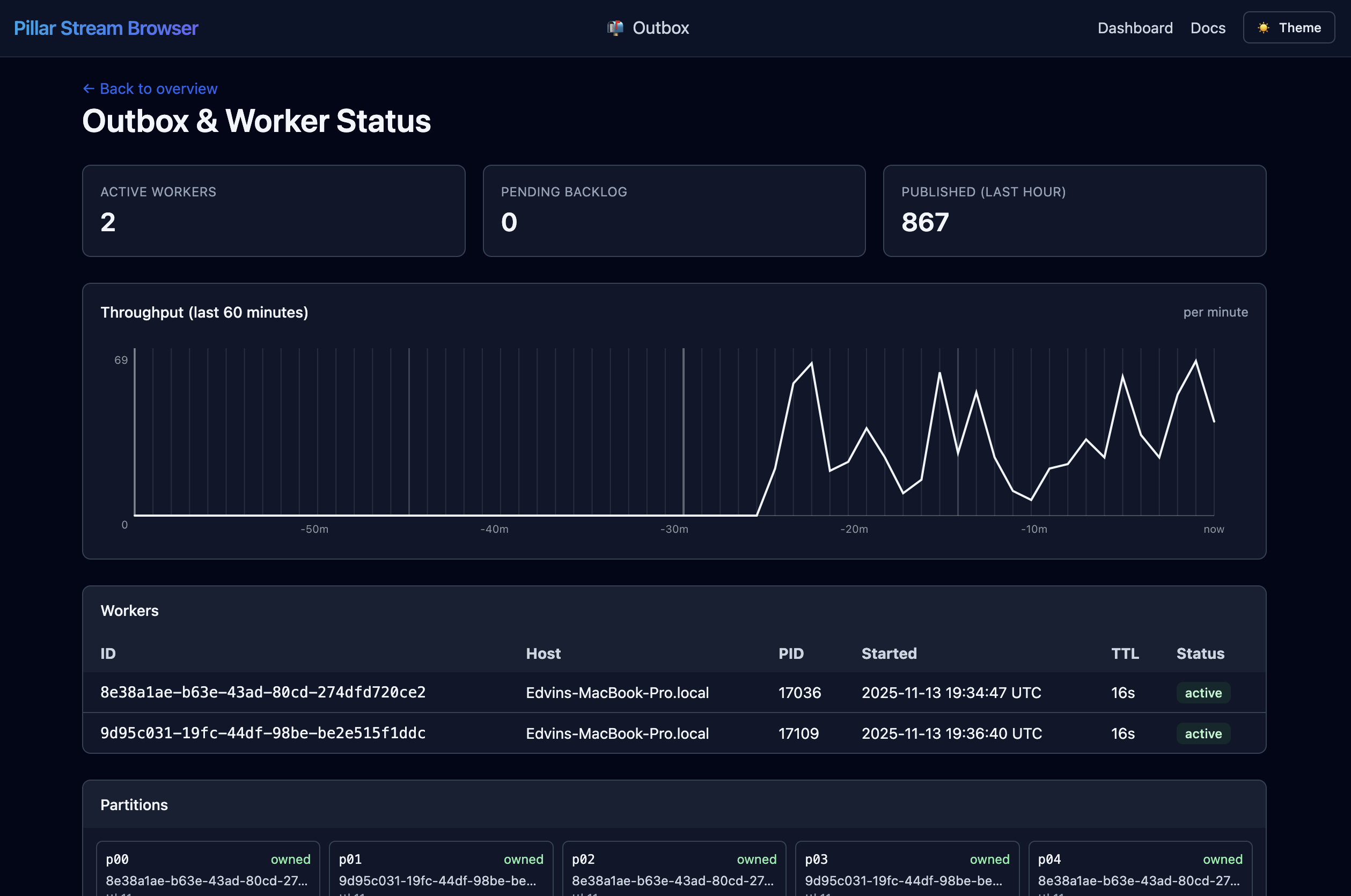
`/{pillar.ui.path}/outbox` (default: `/pillar/outbox`)The {pillar.ui.path} comes from your UI config (pillar.ui.path). The page shows:
- Active workers with heartbeats and TTL
- Throughput for the last 60 minutes
- Partition leases (who owns what, TTLs)
- Outbox messages (Pending / Published / Failed views)
For configuration options, see the configuration → Outbox section.
CLI: Outbox Worker
See outbox-worker.md for the full CLI and UI. Quick start:
php artisan pillar:outbox:workUseful flags:
--no-leasing– single‑worker mode (no leasing)--once– run a single tick and exit--json– emit one JSON line per tick (good for logs)--silent– run without printing--interval-ms=50– add sleep between ticks--window=5– aggregate interactive stats over a 5s window
Failure & retries
- On failure:
attempts += 1,last_erroris captured,available_atis moved forward byretry_backoffseconds. - The message remains pending until published; after successful publication,
published_atis set andclaim_tokencleared. - At‑least‑once: Handlers must be idempotent.
Replay interaction
During replay, publication is disabled (EventContext::isReplaying()): outbox remains silent and your projectors receive events directly from the replayer.
Extending
- Swap the Partitioner to route by tenant, context, or business key.
- Replace the PublicationPolicy to recognize custom attributes/annotations.
- Implement a custom Outbox if you want a different storage (e.g., message broker)—keep pointer semantics if you want consistent rehydration behavior.
See also
- Events & marker interfaces → Events
- Outbox Worker (CLI/UI) → Outbox Worker
- Outbox → Outbox
- EventStore → EventStore